
Dear friends, colleagues and supporters,
As the Guardian reported (1st May) “hope is contagious and science is king… At world-first Santa Marta climate meeting, delegates say it was ‘euphoric’ to finally be focusing on concrete solutions.” Key among them, the significant and much needed steps taken forward on support for the implementation of a Fossil Fuel Non-Proliferation Treaty.
Below is our round-up of the historic Santa Marta Conference, with special attention to our issue – military spending.
TPNS was accredited to the conference as a virtual attendee, was a member of the content and demands working group and made a 2 page submission on the War Machine and Arms Industry as part of the civil society consultation seeking responses to ‘barriers’ and ‘solutions’. The TPNS submission included the call for ‘the creation of a working group to investigate routes by which nations can agree on the universal, equitable redirection of military spending to support Global Just Transition Fund’.
The summary below illustrates the extent to which the Santa Marta Conference has proven to be a turning point for the inclusion of military spending as a legitimate source to tap for climate finance. It has given a major boost to all of us who have been long advocating that runaway military spending belongs alongside debt cancellation, trade justice and tax justice in climate finance discussions.
But this is just the starting point from which we need to move rapidly on to the much wider, much needed global debate on what exactly constitutes ‘defence’ in the face of global boiling and why the climate emergency demands we transform our understanding of it.
Onwards.
Deb & Ho-Chih

THE FIRST CONFERENCE ON TRANSITIONING AWAY FROM FOSSIL FUELS HAS COME TO A CLOSE
Fossil fuels are a driver of economic instability, debt, and conflict. As long as Global South countries are locked into this system, while Global North governments continue to write our financial rules, public resources will keep flowing away from people and toward the systems driving crisis. In Santa Marta, a line has been drawn. Sixty governments pushed by people power came together at a moment of deep global instability — rising conflict, economic volatility, and climate crisis — to say clearly: the era of fossil fuels must end, and the transition must be fast, fair, full, and funded.
Bronwen Tucker, Oil Change International
AN HISTORIC CONFERENCE THAT GAVE MUCH NEEDED HOPE
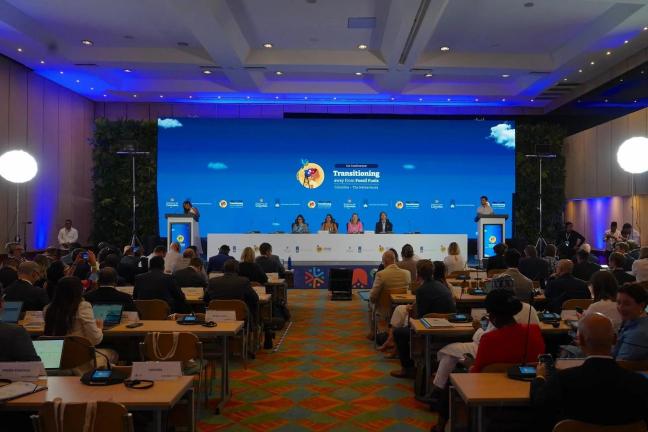
The Santa Marta Conference took place 24-29 April. It was prompted by frustration with the UN climate summits – most recently COP30 in Brazil – where consensus rules mean that fossil fuel interests can block direct discussion of the need to phase out coal, oil and gas. At COP30 forward-looking President Gustavo Petro of Colombia proposed the need for a process that was not subject to such blocking but nevertheless one that could ultimately feed back into the COP process, driving forward the roadmap by which nations must exit fossil fuels.
Almost 60 countries attended: COP31 hosts Australia and Türkiye, European, Latin American, Asian, African and Pacific nations. Some large fossil-fuel producers are on the list, including Canada, Norway, Brazil and Nigeria. The USA, China, India, Russia and petrostates Saudi Arabia, Qatar and the United Arab Emirates were absent, since attendance was limited to countries willing to commit to a phase-out. Those attending represented more than half of global GDP, nearly a third of energy demand and a fifth of fossil fuel supply.
It proved to be a conference that unequivocally boosted hopes that the ‘coalition of the willing’ can truly lead a re-energised process, mapping the practical ways forward away from fossil fuels and into a 100% clean, green just transition, with those historically culpable for the climate emergency, paying up.
A second conference is now confirmed. It will take place early next year on the Pacific island of Tuvalu, co-hosted by Ireland.
SUMMIT DECLARATION & GOVERNMENT DIALOGUES
In the two months lead-up to the conference, there was extensive consultation by the Colombian government with global civil society. Climate Action Network International had the enormous task of facilitating the NGO sector’s overall principles, roadmap and demands documents (600 organisations). In Santa Marta, almost 1,000 organisations united behind what became a single ‘People’s Summit Declaration’ which then fed directly into the government dialogue.
Militarism, military emissions and military spending were integrated across civil society analysis and demands.
SANTA MARTA & MILITARY SPENDING
CLIMATE ACTION NETWORK
The People’s Summit Declaration
https://fossilfreerising.org/declaration

Tasneem Essop, Executive Director of CAN International, said: “CAN International and our member organisations will use every opportunity – nationally and internationally – to ensure this conference lives beyond Santa Marta… The work of implementation begins now.”
Climate Action Network calls on governments to ensure that the final conference report – to be released in the coming months – fully reflects the demands of the movements and peoples who came to Santa Marta: Indigenous Peoples, Afro-descendants, feminists, youth, trade unions, farmers, fisherfolk, and social movements who have fought for decades for this moment. The People’s Summit Declaration deals in demands, not aspirations. Key among them:
- An immediate halt to all new fossil fuel licensing, exploration, and approval. No new coal, oil, or gas projects. No public or private financing of expansion.
- Time-bound, socially equitable national phase-out plans covering both production and consumption, aligned with 1.5°C, integrated into their national climate plans (NDCs), and subject to independent accountability.
- A binding Fossil Fuel Treaty – a legally mandated framework to deliver a rights-based, equitable, and fully funded transition away from fossil fuels, with differentiated responsibilities and clear timelines for Global North and Global South.
- Non-debt-creating, grants-based public finance for the transition. No conditional loans. No structural adjustment. No nation – especially in the Global South – should go into debt to phase out the fossil fuels that wealthy countries burned to build their economies.
- Immediate exit from Investor-State Dispute Settlement mechanisms that allow fossil fuel companies to sue governments for enacting climate policy – and binding safeguards against fossil fuel lobbying and conflicts of interest across multilateral bodies, including the UNFCCC.
- No false solutions. Carbon offsets, Carbon Capture and Storage, ammonia co-firing, and gas as a transition fuel prolong fossil dependence and drain public funds from the decentralised, community-based renewable systems that deliver real emissions reductions – and real economic and social opportunity.
- An end to militarism, imperialist aggression, and resource wars. Wars and militarisation account for an estimated 5.5% of global emissions. Redirecting military spending toward the just transition is not only a moral imperative – it is a climate imperative.

FOSSIL FUEL TREATY
The Double Dividend: How Reducing Military Spending Can Finance a Just Transition
New report launched at the Santa Marta Conference in Colombia. The Double Dividend from the Women’s International League for Peace and Freedom (WILPF) and Fossil Fuel Treaty Initiative makes the case that reducing military expenditure is one of the most significant – and most politically avoided – levers available to finance a just global transition away from fossil fuels. Prepared by our colleagues Katrin Geyer and Genevieve Riccoboni at WILPF, it marks an important moment in the ever-widening integration of military spending into the climate finance and just transition agenda.
Full Report https://www.wilpf.org/publications/the-double-dividend-how-reducing-military-spending-can-finance-a-just-transition-the-fossil-fuel-treaty-as-a-tool-for-justice-and-peace/
Media Release https://www.fossilfueltreaty.org/double-dividend-pr
Ameira Sawas, Head of Research and Policy, Fossil Fuel Treaty:
“A growing, intersectional civil society movement is connecting the dots between militarism, genocide, ecocide and climate injustice. Now, more than ever, the world needs funding for a just transition and for climate justice – not for militarism and expanding violence and injustice. This must involve a concrete plan to reallocate military spending towards the just transition and peacebuilding as part of developing a Fossil Fuel Treaty aimed at ending the expansion of oil, gas and coal; winding down existing production; and accelerating a fair transition to renewable energy with community needs at the core.”
Harjeet Singh, global convenor of the Fill The Fund campaign and founding director of Satat Sampada Climate Foundation:
“It is a profound display of moral bankruptcy that wealthy nations seamlessly mobilized a record US$2.88 trillion for weapons and warfare last year, yet claim the coffers are empty when developing countries demand climate finance. Right now, the richest countries are spending 30 times as much on their armed forces as they are on climate finance for vulnerable nations. Meanwhile, developing nations are losing hundreds of billions of dollars every year to devastating climate impacts they did the least to cause. It is time we urgently shift money away from wars and fossil fuels to address loss and damage and finally deliver genuine climate justice.“
Tasneem Essop, Executive Director, Climate Action Network International:
“War kills people. So does climate collapse. And right now, the money flows in the wrong direction. Governments plead poverty on climate finance while military budgets hit record highs. This is not a funding crisis. This is a political choice. And it is costing lives. What we are witnessing – from Gaza to Cuba and across oil-rich regions – is imperialist aggression and a new colonialism, dressed in the language of security. It is not separate from the climate crisis, but part of the same system: one that extracts, concentrates power, and leaves those least responsible to pay the highest price. Real security means an end to imperialist wars, preventing climate chaos and ensuring justice for those impacted by occupation, wars and climate change.”

