
DOWNLOAD PDFs: Briefing (executive summary) and Full Paper.
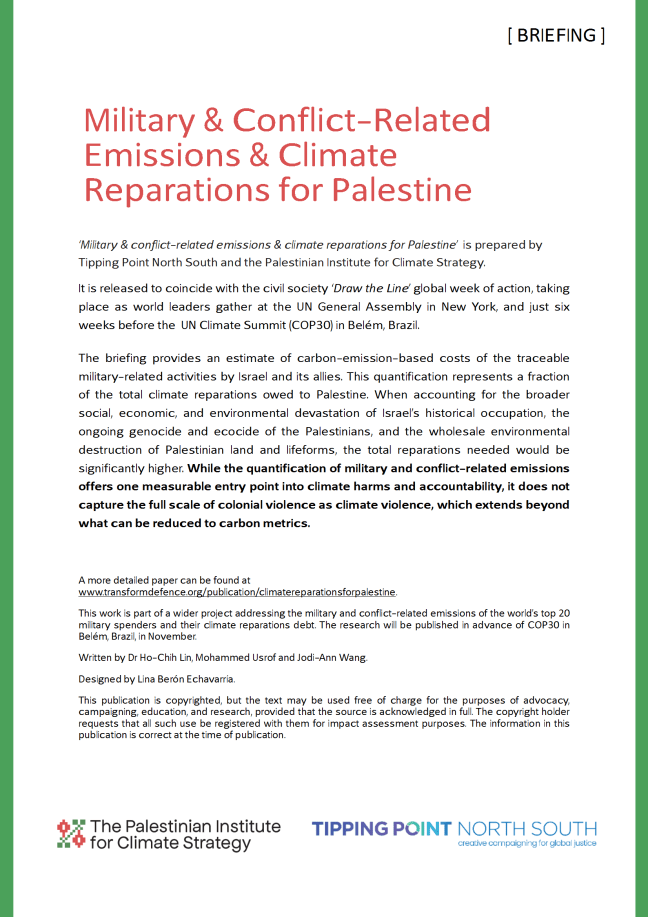
Military & Conflict-Related Emissions & Climate Reparations for Palestine prepared by Tipping Point North South and the Palestinian Institute for Climate Strategy.
In this research the historic military and conflict-related emissions of the 77 years of Israel’s occupation of Palestinian land since its founding in 1948, culminating in the ongoing genocide of Palestinians for nearly two years is quantified. By applying the monetary measure ‘the social cost of carbon’, that is, the long-term social and environmental damage done by emitting one additional tonne of carbon, the paper calculates the climate reparation owed by Israel to the Palestinian people as a result of these historic military and conflict-related emissions.
KEY FINDINGS
To date, the total estimated amount of the military and conflict-related climate reparations owed by Israel and its allies to the Palestinian people since the Nakba is US$148 billion. Of this,
- Israel is responsible for US$103 billion.
- The U.S. is responsible for US$40.8 billion.
- Israel’s allies share further responsibility: Germany US$2.7 billion, France US$1 billion, the UK US$0.5 billion, and Italy US$0.17 billion.
These figures represent the measurable climate liability of military and conflict-related emissions. Yet, as this briefing makes clear, they capture only one entry point into the broader reparations reckoning for Palestine, which must also encompass the wider harms of occupation, genocide, ecocide and systemic destruction of Palestinian life. Many of these aspects are beyond what we can quantify in simplified carbon metrics, and we must not lose sight of this complexity in rebuilding just futures for Palestine.
RECOMMENDATIONS/DEMANDS
- Recognise ecocide as the fifth international crime to be prosecuted by the International Criminal Court alongside genocide, war crimes, crimes against humanity, and aggression.
- Integrate military-linked climate harms into war crime tribunals and ensure that future investigations of Israel’s genocide also include climate and ecological harms as part of the accountability process.
- Recognise Palestinian resource sovereignty and rights over natural resources in reparation frameworks.
- International institutions charged with adjudicating war crimes and reparations to ensure that military- and conflict-related emissions are incorporated into the reparations framework, building on the US$148 billion calculated in this briefing.
- The FRLD (Fund for Responding to Losses and Damages), as well as all climate adaptation finance providers, must recognise the long-term and often irreversible impacts of ecocide and put in place mechanisms for victims of ecocide to access climate finance. Additionally, needs-based assessments of climate finance and the scale of pledged climate finance should account for the finance required as reparations and for rehabilitation resulting from military-induced climate harms.
- The UNFCCC must explicitly recognise the climate and ecological dimension of war and occupation. In particular, the Intergovernmental Panel on Climate Change (IPCC) AR7 Special Report on Cities should include a dedicated chapter on war- and conflict-related emissions, with attention to the wholesale destruction of cities and systems such as Gaza City and its surrounding lands.
Israel and its supporters’ actions constitute both genocide and ecocide, as an act of destruction of people and the environment upon which survival depends. Climate justice requires that reparations account for both the measurable carbon costs and the deeper ecological, cultural, and social destruction that no metric can fully capture.
 Transform defence for sustainable human safety