
BLUE ZONE OFFICIAL SIDE EVENT
DISARMING THE CLIMATE CRISIS: THE TRUE COST OF MILITARISM
13 NOVEMBER
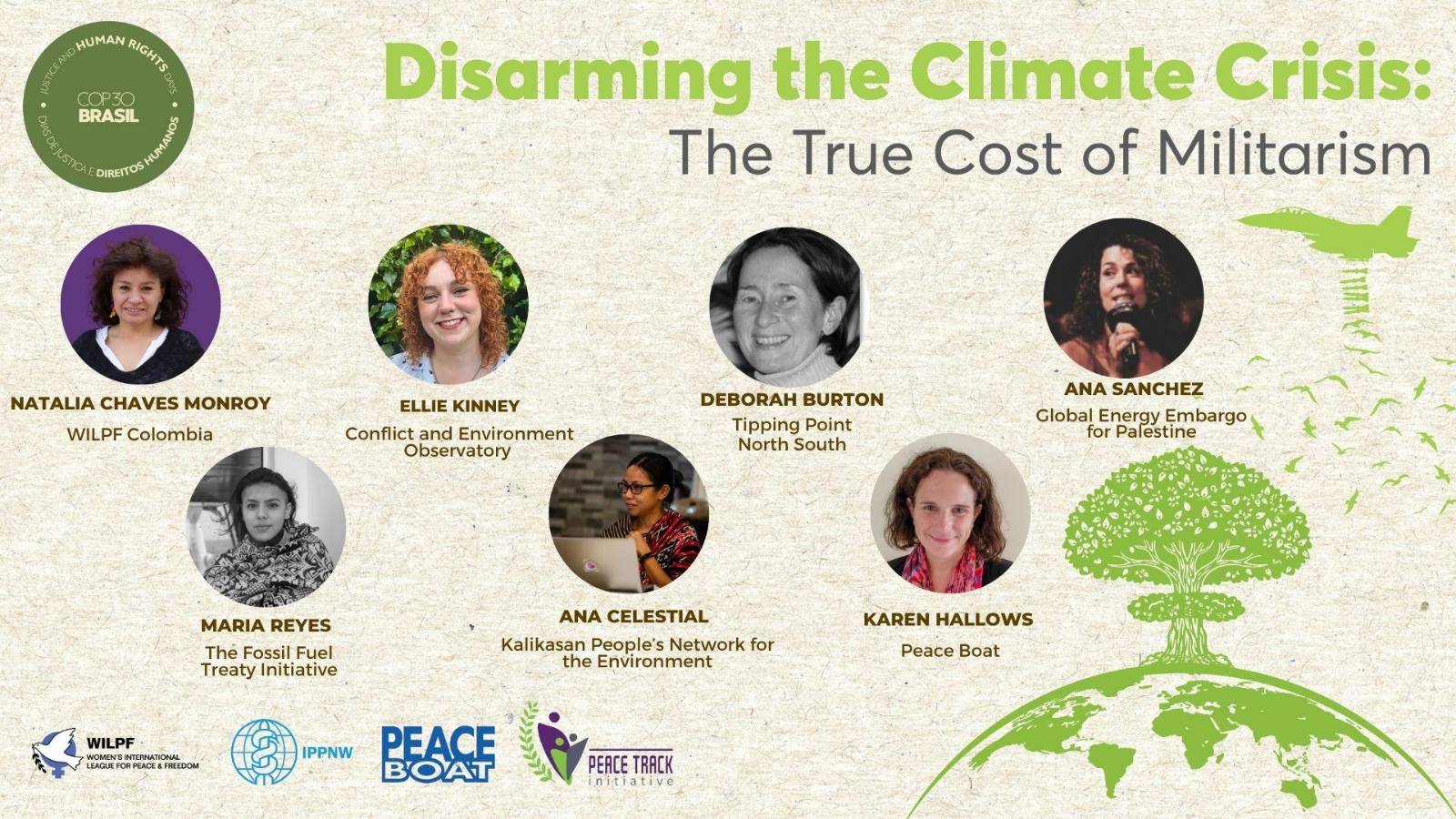
This official side event, co-hosted by IPPNW, Peace Boat, Peace Track Initiative, and WILPF brought together diverse speakers that addressed the deep connections between militarism and the climate crisis — from hidden military emissions and the vast gap between military spending and climate finance to the catastrophic risks nuclear weapons pose to the planet. The event concluded in spotlighting avenues for peace and climate justice – including the Fossil Fuel Treaty to the Global Energy Embargo for Palestine.
Deborah Burton’s contribution was addressing the urgent need to fund public climate finance over military spending.
Transcript
WE NEED TO FUND PUBLIC CLIMATE FINANCE OVER MILITARY SPENDING
For a century, fossil fuels have been – and very much remain – the life blood of modern militaries
Since the Industrial Revolution, militaries have played an integral role in fomenting and later exacerbating the climate emergency; coal was fundamental to the British Empire and later oil was instrumental for the United States to become the supreme superpower in the 20th century.
And in relation to climate change, there is a direct correlation between military spending and military emissions – the more you spend on big ticket fossil fuel-reliant weaponry – warships, jets, tanks, bombs, missiles – the more you emit.
Yet despite the science telling us we have breached 1.5 degrees of warming and are heading for 2.7 degrees on current trends, the big military spenders are driving us into a new arms race
The top 20 military spenders alone, despite comprising a mere 10% of the number of countries in the world, account for more than 80% of the total global military spending.
According to the Stockholm International Peace Research Institute, a staggering $2.7 trillion was spent on militaries in 2024. This marks a more than 9 per cent jump from the previous year—the steepest increase since the Cold War and the tenth consecutive year of growth.
In research just published by Dr. Stuart Parkinson at Scientists for Global Responsibility – it is estimated that for each $100bn increase in military spending, military carbon footprint rises by around 32 million tonnes of carbon dioxide equivalent (tCO2e).
CLIMATE FINANCE IS IN A FIGHT TO THE DEATH WITH MILITARY SPENDING
At COP29 in Baku the Climate Action Network called for $5tr annually for climate finance – instead, parties agreed to increase the old $100bn a year climate finance goal to mean spirited $300bn a year by 2035.
Meantime, public military spending soars, with much of it pouring into the heavily polluting and wildly profiteering arms industry.
AND NOW NATO HAVE A NEW – MUCH HIGHER – MILITARY SPENDING TARGET
The 32 member states of NATO already spend 52 times more on the military than on climate finance,
Our recent research shows that
- NATO’s new 3.5% GDP military spending goal over the next 5 years would deliver total military spending of $13.4 trillion.
- This is a $2.6 trillion increase above current level over a 5 year period.
That extra 2.6trillion would cover
- nearly three years worth of climate finance needs of developing countries at $1 trillion a year
- or it could pay outright for the world’s global electricity grid to be upgraded and made net zero compatible by 2030.
AND LETS TALK ABOUT CLIMATE REPARATION…
…because over decades, militarism has been synonymous with ecological destruction.
Published for COP30, our latest Tipping Point North South report is called “CLIMATE REPARATIONS FOR MILITARY EMISSIONS”.
In it, we estimate that the global top 20 military spenders alone are responsible for
- at least 10 billion metric tonnes of CO2 equivalent (tCO2e) of military-related emissions during the first quarter of the 21th
- This has accrued from the US$40 trillion spent on their militaries since 2001.
- We estimate that collectively they owe the poorest and the most climate vulnerable countries, US$2.67 trillion in reparation for their military-greenhouse-gas-emission-related climate costs.
We suggest that an international military-GHG-emissions-related climate reparation fund paid for by the top military spenders will provide an additional source of international climate finance for developing countries in a way that respects the status quo on Annex II developed countries’ responsibilities for international climate finance.
Furthermore, in the case of Palestine
- we estimate Israel and its key allies in USA and Europe, owe collectively £$148bn climate reparations for their military and conflict-related emissions to the Palestinian people commencing with the occupation since 1948 up to the present-day genocide.
SO WHAT DO WE NEED TO HAPPEN?
The oft-repeated mantra by rich countries ‘there is no money’ does not wash.
There is money for climate finance and it sits, in no small part, in the trillions spent on the big military budgets every year.
As President Lula said at the official opening of this COP30:
“If the men who wage war were at COP30, it would be much cheaper to spend $1.3 trillion a year to end the climate problem than $2.7 trillion to wage war as they did last year.”
We need the ever-wider take-up of growing civil-society calls for the re-direction of a significant percentage of public military spending to be included in overall climate finance provision, especially inside UNFCCC spaces.
As with missing military emissions, we need parties to take this issue onto the agenda. Formally.
Military spending needs to be there alongside an end to fossil fuel subsidy, taxes on polluters and profiteers, and debt cancellation.
This would also deliver a win for UN net zero goal -redirecting and therefore reducing military spending means cutting military-related GHG emissions.
It cannot come soon enough.
 Transform defence for sustainable human safety