
Why we need an excess profits tax on the global arms industry to be levied and directed to international climate finance
The Russian invasion of Ukraine and Israel’s war on Gaza has served to inflate already considerable profit margins of the arms companies who are contracted by governments to develop, manufacture and maintain fossil fuel hungry weaponry.
Tipping Point North South‘s Transform Defence project addresses this issue in its latest publication ‘Excess Profits Tax on the Arms Industry‘. We believe the time has come to put them in the climate polluter and profiteer frame. It is time for them to pay up.
Nick Dearden, Director of Global Justice Now, says in his foreword to the publication:
As the world becomes less stable, and violence proliferates from Gaza and Ukraine to Yemen and DRC, these masters of war, are making out like bandits, returning eye-watering dividends to their financiers and shareholders.
Read (i) executive summary (ii) the full document [PDF]
‘Excess Profits Tax on the Arms Industry‘ estimates $30 billion per annum can be raised for climate finance from arms industry polluters.
- USA $15bn a year (based on SIPRI figures for year 2021)
- Europe $6bn a year
- UK $2bn a year
- France $1.4bn a year
- Russia $890mn a year
- China $5bn a year
Moreover, in times of war, we estimate that an additional punitive excess profits tax on war profiteers could deliver considerably more.
Had our war profiteers tax been applied in 2024 (for Ukraine and Gaza wars), an extra $52bn would have brought the 2024 annual total to $82 billion. This tax alone would be more than four fifths of the pledged (but never fully fulfilled) $100 billion a year climate finance by developed countries to developing countries.
Key Facts
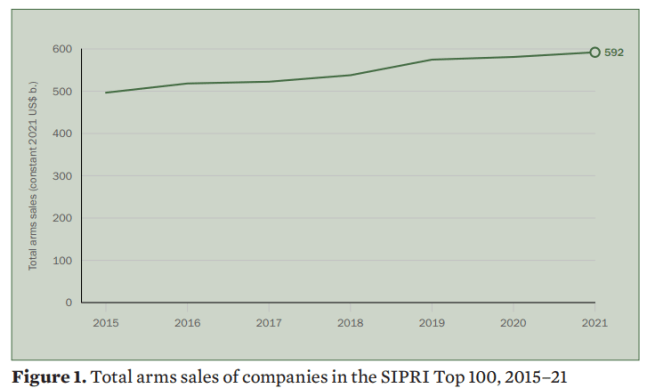
The top 100 arms companies accounted for $592 billion in arms sales in 2021 (pre Ukraine).
The top 100 arms companies accounted for $592 billion in arms sales in 2021 (pre Ukraine).
The top 20 arms companies alone account for two thirds of the total arms sales in the world and come from just a handful of countries: USA, China, Russia, UK, France and Italy.
In the seven years to the 2030 target of 45% cuts to GHG emissions, the fossil fuel reliant global military will receive approx $15 trillion from their governments – a great deal of that will go, in turn, to the hugely profitable arms industry.
The global military and its supply chain (the arms industry) is estimated to account for 5.5% of global GHG emissions.
In 2020 public climate finance was estimated to be $321bn in 2020 – less than 20% of the $1981 billion sum spent by global military in the same year.
It’s time to put the arms industry in the climate change frame.
It’s time for an excess profits tax in peace and war on the global arms sector.
Report
READ AND DOWNLOAD (i) executive summary (ii) the full document [PDF]
RECOMMENDATIONS
-
- An excess profits tax on top 100 arms companies (ranked by SIPRI). A typical profit margin for an arms company is 10%. A 100% excess profits tax on profits over 5%, i.e. 5% on revenue in this case, will bring the profit margin down to the more reasonable level at 5%.
- A war profiteers’ tax on arms companies’ revenue generated by wartime sales. Arms companies greatly inflate their product prices during wartime, taking advantage of scarcity and urgency. Assuming an inflated profit margin of 50%, a 100% war profiteers’ tax on profits over 5%, i.e. 45% on revenue in this case, will bring the profit margin down to the more reasonable level at 5%.
- All excess profit tax revenue to be directed toward the climate finance needs of the most climate vulnerable nations, many of whom have been or are on the frontline of both conflict and climate change, with the former also a contributor to latter, in the form of military/arms trade GHG emissions.
- Calls for an excess profits tax on the arms industry and cuts to military spending (such as the Five Percent Formula) to be included in all climate finance demands at relevant international climate and finance meetings including annual COP meetings and the Bonn Climate Conferences.
- Support for UN New Agenda for Peace. Transformation of our collective foreign, security and defence policy making to rely less on arms and aggression and more on diplomacy and peaceful means. Without change, the oil industry and the arms industry will always be the most influential stakeholders / lobbyists in our governments that inevitably always makes decisions that deteriorate our and the environment’s wellbeing but benefit these industries greatly financially. [Note that there is no modern military without the arms and oil industries.
- Call for the term ‘military aid’ to be replaced by ‘military finance’.

Transform Defence is a Tipping Point North South project. It was launched in December 2020 with 2 publications: Indefensible and Value for Money.
All publications are here.
 Transform defence for sustainable human safety